
Echo Chambers, Bubbles and Social Media
Are you in a social media echo chamber? Does it even matter?

Hiya 🦐! I’m Amy from The Subsnack. I chat about health and fitness through a weight inclusive, non BS lens helping you to navigate fitness free from fads, trends & misinformation. If you are new to this page, pop your email below to ensure you receive my posts.
I had never heard of the term echo chamber until a few years ago.
The deeper I went into intuitive eating and finding more accounts that were no longer focusing on weight loss, the more the content I used to follow, and was still holding on to (the likes of James Smith ffs) seemed unnecessarily polarising.
Over time, my feed shifted away from weight loss accounts and became more diverse. Different types of bodies, people doing fitness and health on their own terms and just generally what seemed like an abundance of different experiences and opinions. You know, a reflection of the actual world.
After unfollowing James Smith, because public shaming of others is just not my cup of tea and never has been, I was sent one of his posts from Facebook. And this was one of the first times I’d ever heard of an echo chamber.
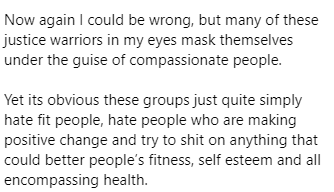
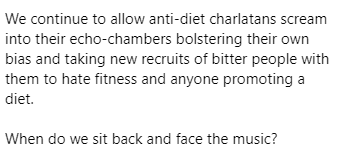
You can read the full post here (discretion advised as stigmatising language and stereotypes are included).
At the time I worked in a gym and since weight loss and diets are the societal default, I didn’t really see myself as being in an echo chamber. Also ironic that someone shouting at others for being in an echo chamber is clearly in one himself since there seems to be a curated misunderstanding of what it means to reject the idea that dieting is the best/only way to be healthy.
What’s an echo chamber?
The term "echo chamber" became popular in the 2000s, thanks to Cass Sunstein, who used it to describe how social media can create isolated online communities where people only hear opinions similar to their own. This leads to a reinforcing of shared beliefs and exclusion of opposing views, contributing to increased polarisation and the spread of misinformation.
Similarly, Eli Pariser introduced the concept of the "filter bubble," which refers to how algorithms on platforms like Facebook and Google show users only content that matches their existing beliefs, limiting exposure to differing opinions. This can create a form of intellectual isolation where people only see viewpoints they agree with.
While both terms highlight how digital media can reinforce isolation, critics argue that this effect is not solely due to technology but also to human tendencies to favour like-minded opinions. Thus, while digital platforms play a role, the issue of intellectual isolation is also shaped by individual and societal factors. In other words, we can’t always blame algorithms as our brain chemistry is as much to blame for echo chambers.
There’s more bubbles…
Then there’s ‘bubble theses’, which suggest that people are often overly confident in their own beliefs and judgments, which can lead to misconceptions. This tendency to stick firmly to one's own views, even when they might be wrong, is made worse by digital platforms. These platforms can make it easier for people to stay within their own belief bubbles, reinforcing their existing views and making them less open to different perspectives
Woods’s "epistemic bubble" explains that people often can't distinguish between what they truly know and what they believe they know. Since belief and knowledge feel the same, we might think we know something for sure even when we don't - which feels fairly existential to me. Realising we might be wrong doesn't help much unless we get outside input to challenge our views.
Magnani’s "moral bubble" suggests that our moral beliefs are shaped by social and cultural backgrounds, making it hard to see beyond our own views. Arfini’s "ignorance bubble" adds that we tend to overestimate what we know and underestimate our ignorance.
Epistemic bubbles provide comfort by shielding us from what we don’t know, but when our beliefs are challenged, it can create "epistemic discomfort." This discomfort can either prompt us to question our beliefs or reinforce them. People tend to double down when their views are challenged.
Social media
On social media, this discomfort is heightened due to the immediate and unmediated nature of interactions. People often react to opposing views with defensiveness rather than open-mindedness, reinforcing their existing beliefs. This is because online platforms blend various social contexts, making it harder to navigate and interpret information, which can lead to a stronger adherence to one's own views. This is not necessarily a bad thing, more the pack mentality and protective nature of our feral brains.
Some researchers want us to stop blaming the algorithm and take responsibility for how we view different opinions online, especially when they are uncomfortable or challenging. This approach not only aligns better with existing research but also explains why users often become more entrenched in their beliefs. It acknowledges that while some users may become more open-minded, many will reinforce their existing views to avoid discomfort.
How can we avoid chambers and bubbles?
If we go back to James Smith’s post above, it is quite evident that he is committed to misunderstanding ‘anti diet’ professionals and advocates. It shows the doubling down of viewpoints and conflates anyone who wants to see less weight focus in fitness as…hating fitness? Categorically not true. I remember seeing a post taking the piss out of professionals like me, saying something along the lines of ‘If you don’t help people lose weight what do you do?’ with the insinuation that what I do is actually not a lot. Like using online calorie calculators, writing unqualified meal plans, writing push, pull, leg workout splits and getting people to send over the measurements they took somehow makes you a more hard working personal trainer or coach.
Interestingly, personality traits have been found to impact echo chamber dynamics. I don’t know Smith personally, he’s probably a laugh, but online he gives off grandiosity, a need for admiration and a sensitivity to criticism, which means he is likely to always reinforce his own opinions.
A personality trait associated with breaking echo chambers is called ‘trait mindfulness’. Trait mindfulness is a personality trait that describes a person's tendency to be aware of the present moment without judgment and with an open attitude. It's also known as dispositional mindfulness. Trait mindfulness is a natural difference between people, while mindfulness practices help people develop mindfulness as a skill. Trait mindfulness is associated with health behaviours, empathy and adaptative cognitive processes.
If escaping echo chambers seems challenging, the best advice is to actively seek out diverse perspectives. Make a conscious effort to follow and engage with sources, communities, and individuals that offer different viewpoints from your own (and no I don’t mean listen to people who are harmful bigots. I mean good people who are just different to you).
How do you feel when you encounter opinions that contradict your own? If you immediately feel angry, dismissive, or uncomfortable, it may indicate you’re used to only seeing content that aligns with your views. This doesn’t mean you have to agree with everything you encounter, but exposing yourself to a variety of opinions can help broaden your understanding and reduce the impact of echo chambers on your thinking.
I personally like to follow news sources like ‘ground news’ which show you how headlines from the same incident are different depending on which media outlet is reporting it.
I don’t really think being in the safety of a social media echo chamber is a bad thing either, provided that echo chamber is not used to denounce others for thinking and feeling slightly differently about something than you do. It’s just one more thing to be aware of. Anyway.
Keep moving,
Amy x
Pssssst… It takes momentum to find, read and review research papers to give you this alternative reality of health and fitness. Consider subscribing or joining the Snack Pass. Ta.
Figà Talamanca G, Arfini S. Through the Newsfeed Glass: Rethinking Filter Bubbles and Echo Chambers. Philos Technol. 2022;35(1):20. doi: 10.1007/s13347-021-00494-z. Epub 2022 Mar 15. PMID: 35308101; PMCID: PMC8923337.
Avin C, Daltrophe H, Lotker Z. On the impossibility of breaking the echo chamber effect in social media using regulation. Sci Rep. 2024 Jan 11;14(1):1107. doi: 10.1038/s41598-023-50850-6. PMID: 38212365; PMCID: PMC10784531.
Cinelli M, De Francisci Morales G, Galeazzi A, Quattrociocchi W, Starnini M. The echo chamber effect on social media. Proc Natl Acad Sci U S A. 2021 Mar 2;118(9):e2023301118. doi: 10.1073/pnas.2023301118. PMID: 33622786; PMCID: PMC7936330.
Zhong F, Gu C. The impact of health information echo chambers on older adults avoidance behavior: the mediating role of information fatigue and the moderating role of trait mindfulness. Front Psychol. 2024 Aug 16;15:1412515. doi: 10.3389/fpsyg.2024.1412515. PMID: 39228876; PMCID: PMC11370067.
Song X, Guo S, Gao Y. Personality traits and their influence on Echo chamber formation in social media: a comparative study of Twitter and Weibo. Front Psychol. 2024 Feb 8;15:1323117. doi: 10.3389/fpsyg.2024.1323117. PMID: 38390405; PMCID: PMC10881801.
This was a good read and a welcomed reminder! I have been guilty of being in my own echo chamber, maybe it comes along with the pendulum swing of moving away from diet culture. But now I feel I have a more nuanced perspective of things.